
HORMONE THERAPY
PRP Hair Restoration: Regrow What's Yours
No surgery. No synthetic chemicals. Just the power of your own blood working to bring your hair back.
“Losing your hair doesn’t have to be permanent — and the solution might already be inside you.”
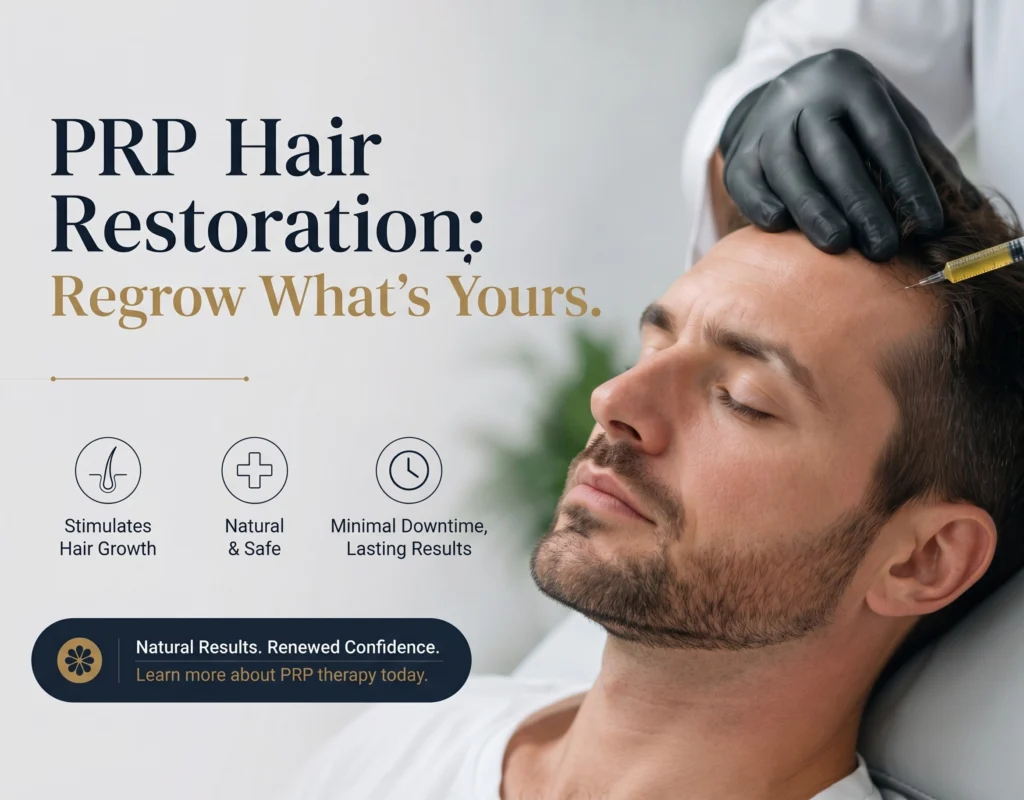
If you’ve been Googling “best hair loss treatment”, “how to stop hair thinning”, or “non-surgical hair restoration near me”, you’ve landed in the right place. PRP hair restoration is one of the fastest-growing treatments in aesthetic medicine, and for good reason: it works with your body, not against it.
In this guide, we’ll break down exactly what PRP is, how it works, what to expect during treatment, and why so many patients are choosing it over pills, wigs, or invasive surgeries.
What Is PRP Hair Restoration?
PRP stands for Platelet-Rich Plasma. Don’t let that term intimidate you, it simply means a concentrated form of your own blood that’s loaded with powerful healing proteins called growth factors.
These growth factors are the same natural chemicals your body uses to heal a cut or repair a sore muscle. Scientists discovered that when you inject this concentrated plasma directly into the scalp, it wakes up dormant (sleeping) hair follicles, strengthens the ones that are weakening, and encourages new hair growth from the inside out.
In plain terms: PRP tells your hair follicles to stop dying and start growing again.
Key Insight
PRP doesn’t create new follicles. Instead, it revives the ones you already have, which is why starting treatment early (before follicles are completely gone) gives the best results. The sooner you act, the more hair you can save.
How Does PRP Hair Treatment Work?
The entire process is straightforward, safe, and done right in your doctor’s office. No hospital stay. No general anesthesia. Here’s exactly what happens, step by step:
Step 1: A Small Blood Draw
Your provider draws a small amount of blood from your arm, about the same as a routine lab test. This takes just a few minutes and is barely noticeable.
Step 2: Spinning in the Centrifuge
Your blood sample is placed in a special machine called a centrifuge that spins rapidly to separate the plasma (the liquid part of your blood) from the red blood cells. This creates the “platelet-rich plasma”—a golden-yellow liquid packed with healing growth factors.
Step 3: Scalp Preparation
A numbing cream or local anesthetic is applied to your scalp so you stay comfortable throughout the procedure. Most patients report minimal to no pain.
Step 4: Targeted Injections
Using a fine needle, your provider carefully injects the PRP into the specific areas of your scalp where hair is thinning or has been lost. The injections target the base of the hair follicles for maximum absorption.
Step 5: You’re Done, Go Home!
The whole appointment takes about 60–90 minutes. There’s no recovery time needed. Most patients return to work or daily activities the same day.
Facts
- 70% of patients see visible improvement after 3 sessions
- ~90min average session time — no hospital stay needed
Why Is PRP a Great Option for Hair Loss?
With so many hair restoration products and treatments on the market—shampoos, supplements, medications, and surgeries—it’s fair to ask: why choose PRP?
Here are the reasons patients and doctors love it:
100% Natural and Your Own
PRP uses your own blood. There are no synthetic drugs, no foreign chemicals. Your body recognizes it immediately, which dramatically reduces the risk of allergic reactions.
Non-Surgical
No scalpels. No stitches. No general anesthesia. PRP is a minimally invasive in-office procedure with no surgical risks or recovery time.
Safe Track Record
PRP has been used safely in orthopedics, wound healing, and dentistry for decades before being applied to hair restoration. It has a well-established safety profile.
Addresses the Root Cause
Unlike topical sprays that just coat hair strands, PRP works at the follicle level, targeting the actual source of hair loss for lasting results.
Pairs Well With Other Treatments
PRP can be combined with minoxidil, hair transplants, or microneedling to amplify results. It’s a powerful add-on to almost any hair care plan.
Works for Men & Women
Whether you have male-pattern baldness, female-pattern hair loss, or thinning from stress or hormones, PRP is an effective solution for all hair types and genders.
Who Is PRP Hair Treatment Right For?
PRP works best for people who are in the early-to-moderate stages of hair loss. It’s particularly effective for:
✔️ Men with Androgenic Alopecia (Male Pattern Baldness)
If your hairline is receding or the crown of your head is thinning, PRP can slow that process significantly and often reverse it in areas where follicles are still active.
✔️ Women with Thinning Hair
Women who notice their part getting wider, more scalp showing, or overall volume loss are excellent candidates. Female hair loss is often hormonal—and PRP addresses the follicle health directly regardless of the cause.
✔️ People with Alopecia Areata
This autoimmune condition causes patchy hair loss. PRP has shown promising results in stimulating regrowth in affected areas.
✔️ Post-Partum Hair Loss
Many women experience significant shedding 3–6 months after giving birth due to hormonal shifts. PRP can accelerate the recovery of hair density during this period.
Important to Know
PRP works best when there are still living follicles present. If an area of the scalp has been completely bald for many years, the follicles may be gone—and PRP cannot create new ones from scratch. This is why early treatment is key.
Book a consultation to find out if PRP is right for your specific stage of hair loss.
What Results Can You Realistically Expect?
We believe in honest, transparent communication—because we want you to feel confident, not misled.
Timeline for Results
→ Weeks 2–6
Reduced hair shedding—one of the first signs it’s working.
→ Months 2–3
Noticeable new baby hairs starting to emerge.
→ Months 4–6
Significant improvement in density, thickness, and coverage.
→ Month 12+
Full results visible; maintenance sessions recommended every 6–12 months.
Most treatment protocols recommend 3 sessions spaced 4–6 weeks apart for the initial phase, followed by maintenance treatments to sustain results. Your provider will customize a plan based on your specific needs.
Table of Contents

Trusted Care
Triple Board-Certified Physician
17+ years of experience in specialized women s healthcare.
Piscataway, NJ
908-300-7227
Frequently Asked Questions
1. Is PRP Hair Treatment Painful?
Most patients describe it as a mild pressure or tingling sensation. A numbing cream is applied beforehand, making the procedure very comfortable. Any sensitivity typically fades within a few hours.
2. How Many PRP Sessions Do I Need?
Most providers recommend an initial series of 3 treatments, spaced 4–6 weeks apart. After that, maintenance sessions every 6–12 months help preserve your results long-term.
3. Are There Any Side Effects?
Because PRP uses your own blood, the risk of allergic reactions is extremely low. Some patients experience mild redness, scalp tenderness, or slight swelling at injection sites; these typically resolve within 24–48 hours.
4. Does PRP Work for Everyone?
PRP is highly effective for most patients in the early-to-moderate stages of hair loss. Results vary based on age, health, genetics, and how advanced the hair loss is. A consultation with a qualified provider is the best way to assess your candidacy.